
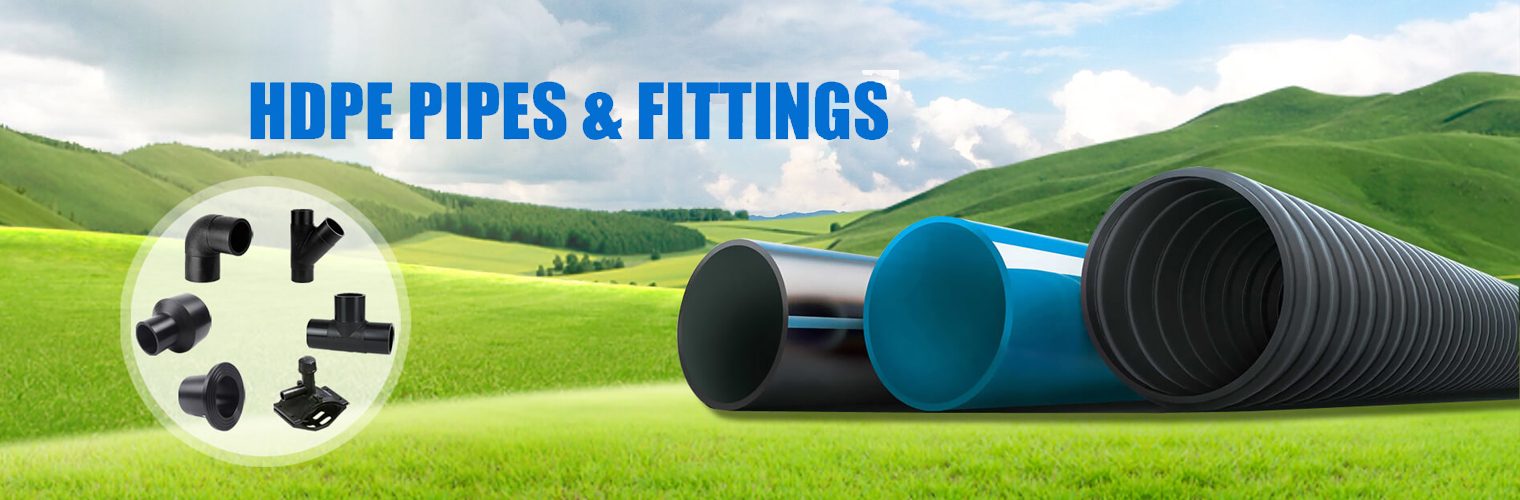


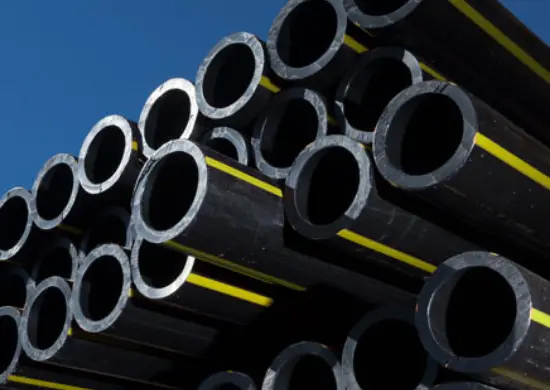


High density polyethylene, or HDPE as it is commonly known, is created from ethylene, which can be produced from either crude oil or natural gas. PE pipe is incredibly robust, long-lasting, flexible, corrosion-free, and chemically resistant.
Due to its physical characteristics, leak-free joints, and lower maintenance requirements, HDPE pipe is affordable and has long-term economic advantages. The HDPE pipe service life is tentatively estimated by the institute to be 50–100 years.
HDPE pipes may be fully adapted. They offer incredibly advantageous qualities, are lightweight, strong, easy to install, and thermally and corrosion resistant. Additionally, a range of dimensions, lengths, and wall thicknesses are offered for HDPE pipe products. They are therefore commonly used in directional digging, river crossing, and pipe bursting.
In addition to being utilized extensively in residential and commercial liquid delivery systems, HDPE pipes are also used to transport wastewater, chemicals, potable water, slurries, and other liquids.
A bend radius of 25 times the normal pipe diameter is possible with PE-HD pipe. In comparison to piping systems manufactured from other materials, this can reduce the number of fittings needed for directional adjustments. In addition, PE-HD pipe's elasticity makes it ideal for dynamic soils and earthquake-prone regions. For pressure applications, PE-HD pipe can withstand repeated pressure surges that are greater than the pipe's static pressure rating.
HDPE pipe can be thermally fused together to create leak-free joints that are as sturdy as the pipe itself. Potential leak spots every 2 to 6 meters—commonly found in concrete, PVC, and ductile iron pipe—are eliminated by thermal fusing. Other pipe joining techniques' infiltration and exfiltration issues are likewise resolved by leak-proof junctions. Fused joints do not need pricey thrust restraints or thrust blocks because they are self-restraining.
HDPE pipe is immune to chemical deterioration and does not corrode over time like other materials. Additionally, it is far more flexible and can adapt to various ground movements and soil conditions. Its minimal weight makes it simpler to handle, transport, and repair, which lowers expenses.
At 32 degrees Fahrenheit, PVC pipe reaches its crystalline temperature and becomes as fragile as glass. The crystalline temperature of HDPE pipe is -180 degrees F, which means that there is less chance of failure. In reality, water inside HDPE pipe can freeze and thaw repeatedly without the pipe is becoming permanently damaged.
No. The flexibility, hardness, and chemical resistance of HDPE pipe are well recognized. Due to its exceptional ductility and durability, PE pipe is able to tolerate significant pressure variations. PE pipe is a great option for dynamic soils and earthquake-prone places because of its performance qualities, which include being flexible enough to be placed and put together in difficult and tough settings while also being sturdy, long-lasting, and corrosion-resistant.
The size of the moulds that are utilized, among other things, affects the density of HDPE pipe products. The most widely used colorant in terms of hues is black, which is utilized to increase the HDPE pipe's UV resistance. Although there are other color options on the market, they are rarely used.
Yes. When created, utilized, or burned, it is secure. Since there is no water loss through the fused joint, it helps preserve both water and power.
HDPE pipe installations in water applications have already successfully served for 50 years in many cases. The HDPE pipe industry places a cautious 50–100 year service life estimate on it. This has to do with future generations saving money on replacement prices.
Rajkee Pipes is one of the leading HDPE pipe manufacturers and supplier in all major cities, including Addis Ababa, Ghana, Kenya, and Ethiopia and many more.
You can buy HDPE pipe in coils, reels, or straight lengths (joints).
HDPE and polyvinyl chloride (PVC) pipes resemble one another in many ways, including their resistance to bacterial and chemical accumulation. Many individuals are confused when they realise that they are distinct because they use them in many of the same applications. To understand how each might be used most successfully, it is crucial to make a distinction between the two.
To start, while both are regarded as plastic piping, PVC is produced using a vinyl polymer, whereas HDPE is a petroleum waste.
Also more resistant to corrosive substances and high-event heat conditions are HDPE pipe goods. For instance, PVC may only last three years but HDPE can resist over 20 years of exposure to UV rays from the sun.
There are more ways to install HDPE pipes than PVC pipes, which is another important distinction between the two. HDPE pipes can be installed using these techniques as well as horizontal and directional bore techniques, however PVC pipes can only be installed using the drop burial and open trench procedures.
Molds, different additives, and polymerized ethylene, a petroleum byproduct, are all used in the production of HDPE pipes. The final HDPE pipe products and pipe fittings are made with the addition of these additives, which also include colorants, stabilizer, softeners, crosslinking agents, and others.
An overview of the production of HDPE is shown below:
Step 1: The excess moisture in the granules is eliminated by moving the HDPE resin from a storage silo into a drier. The resin is heated until it melts after it has dried.
Step 2: The extrusion technique is applied to the molten polyethylene resin. If you're not aware with the procedure, it basically involves forcing heated polythene resin through a bore under high pressure to give the completed pipe or pipe fitting the desired shape.
Step 3: After the HDPE pipe or pipe fitting has been manufactured, it is transferred to a cooling tank where it is gradually chilled to prevent distortion.
HDPE pipe products are quite safe to use, even in situations involving potable water. HDPE pipe production is subject to stringent regulations, and respectable producers only work with polyethylene compounds that have been pressure-rated and authorized by authorities like the National Sanitation Foundation (NSF) International.
Additionally, HDPE piping has one of the lowest life cycle costs when compared to other comparable products. It also boasts benefits for water conservation, leakage that is significantly reduced or nonexistent, no deterioration in flow capacity over time, less maintenance requirements, fewer new water treatment facilities, and seasonal water main breaks.
According to conservative estimates, HDPE pipe products have a service life of at least 50 years. As a result, you will eventually spend less on replacement prices. Due to its chemical and corrosion resistance, HDPE is a non-toxic substitute for other piping materials and has a lower impact on the environment.
Additionally, HDPE pipes are better suited for trenchless installation techniques than other conventional pipe materials like steel because they are significantly simpler to install and handle. They can be bent without additional connections thanks to their flexibility, and they are simple to install in a variety of shapes and sizes across uneven ground.
As a result, HDPE pipe products are a great choice for a variety of applications because they offer the optimal blend of affordability, environmental friendliness, and strength.
HDPE is a ductile material and has exceptional impact strength. HDPE Pipes superior impact strength provides a piping system that is near impervious to impact damage and to damage from improper tapping. In the real world, engineers understand that pipes must be tough and resist impact and handling damage. HDPE pipes are field tested and proven to be impact tough.
The standardized butt-fusion method allows HDPE tubing to be joined quickly and reliably. Matching ends of pipes that need to be linked are lined up in this operation, and the surfaces are heated using ordinary tools until they are molten. The melt faces flow together when mild pressure is applied, generating a monolithic, homogeneous junction that, as the material cools, produces joints that are at least as robust as the pipe itself.
There are several other well-known heat fusion techniques that are used to join HDPE pipe, including as saddle fusion and electrofusion, which are both particularly well-suited for attaching pipe to fittings, making tie-ins, or performing repairs. .
No. When HDPE pipe is properly "hot" tapped, there won't be any splitting because of the ductile nature of HDPE and the design of the fittings used for tapping.
No. There are currently no known solvent cements or adhesives that are strong enough to link HDPE pipes or that are suitable for pressure sealing. The only techniques for joining HDPE pipe are heat fusion, which includes butt fusion, electrofusion, saddle fusion, and mechanical connectors.
